Exit

FIRST SHIFT

Robots stepping off transport trailers into a cold city square, shot like a news crew was there.

All films
Near future 0:15 16:9 65.000 points

What it was made with

Still engine Nano Banana Pro
Film engine Kling 3 Pro
Shots 3 chained, 5s each
Ratio 16:9
Genre Documentary
Lens 35mm, f/2.8

This one is deliberately unglamorous. The still asks for documentary realism, cold fog, sodium lamps and real people watching, and the three clips only widen and then narrow again: out of the trailers, over the whole city, and back down into one face.

Shot by shot

1

The frame everything grows from

Nano Banana Pro 16:9 still, 5.000 points
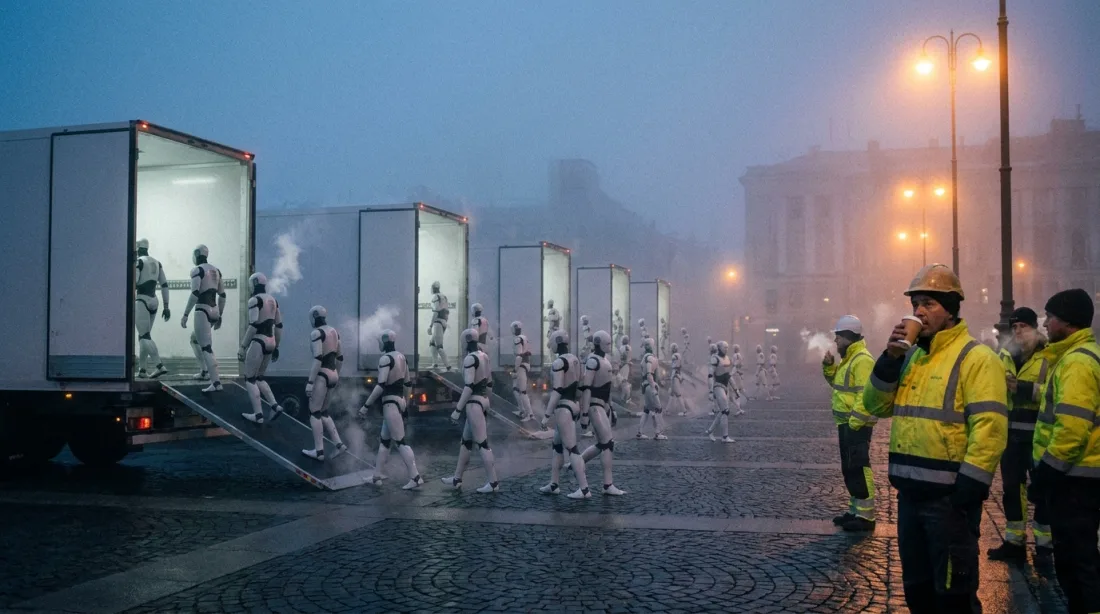
Documentary realism is a written instruction, not a mood. Fog, breath and wet cobbles do the rest.

Cold blue dawn in a wide city square under low fog: a line of unmarked white transport trailers with their rear doors open, and out of them columns of identical matte white and graphite humanoid robots stepping down in perfect formation onto the wet cobbles, steam rising off their shoulders in the cold. Human workers in hi-vis stand to one side watching, breath visible, one holding a coffee cup frozen halfway to his mouth. Shot on a 35mm lens at f/2.8, documentary realism, cold desaturated palette with warm sodium street lights still on, volumetric fog, film grain, horizontal 16:9.
2

Shot one, out of the trailers

Kling 3 Pro, image to video 5 seconds, starts from the still above, 20.000 points

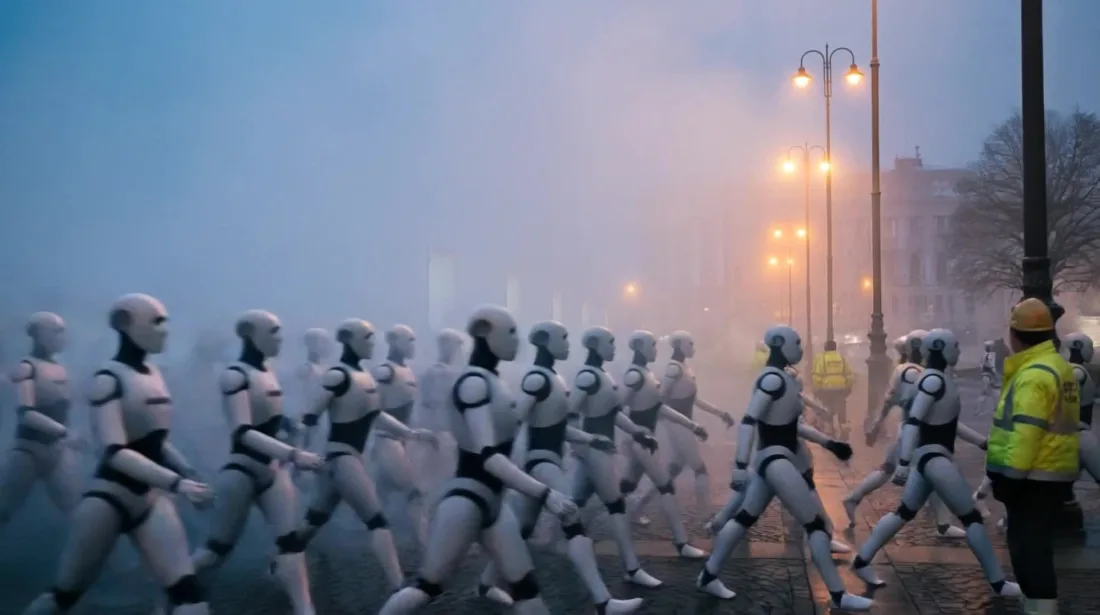
The closing frame carries over, so the robots stay identical from clip to clip.

Continuing the same unbroken shot with no cut: the columns keep pouring out of the trailers and begin to march in step across the square, hundreds of them filling the frame, footfalls landing together, fog pushed aside by their movement. The camera tracks backwards low in front of the leading rank while the watching workers fall behind on both sides. One continuous take, 5 seconds.

3

Shot two, over the city

Kling 3 Pro, image to video 5 seconds, starts from the frame above, 20.000 points

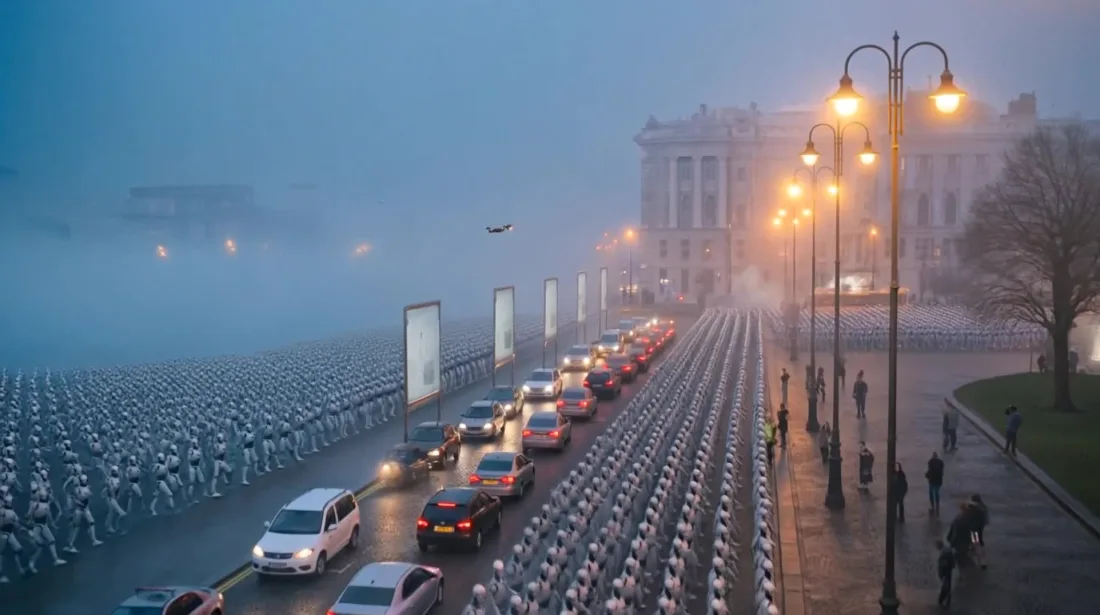
The wide clip is where the scale lands: thousands of them, in every street.

Continuing the same unbroken shot with no cut: the camera lifts and flies forward over the marching ranks, revealing thousands of identical humanoids filling every street leading off the square, traffic stopped, people on the pavements holding up phones, drones hovering above. The city wakes up around a machine army that never breaks step. One continuous take, 5 seconds.

4

Shot three, one looks back

Kling 3 Pro, image to video 5 seconds, ends on the visor, 20.000 points

The film ends on one machine looking into the lens. Small ending after a big one.

Continuing the same unbroken shot with no cut: the camera drops back down into the ranks and settles on one robot at the edge of the column, which slows, turns its head and looks directly into the lens, the city lights reflected in its blank visor while the others keep marching past on both sides. The camera pushes slowly into the visor and holds, ending on a still hero frame. One continuous take, 5 seconds.

What every shot refuses

One negative prompt runs on every clip. It is the same list each time, which is half the reason the film holds together.

cut, scene change, cartoon, video game look, plastic CGI, warped limbs, extra fingers, melted faces, real brand logos, text, watermark, handheld shake, blurry mush

The rules behind it

Ask for documentary realism and available light by name, or the engine reaches for a blockbuster grade.
Put ordinary people in the frame. They are what makes the machines read as real.
Go wide in the middle clip, then come back to one subject at the end.
Say "identical" about anything that repeats, or every copy drifts.
A look into the lens is the cheapest ending there is, and the strongest.

Your own arrival

The same setup, empty and waiting for your scene. Fill in the brackets, generate the still first, then run the clips one after another with the frame you liked as the start.

Continuing the same unbroken shot with no cut: [what arrives and what it does in these five seconds]. The camera [tracks backwards low / lifts and flies forward / drops back down and pushes in]. One continuous take, 5 seconds.